

What if Calling Out Evil Starts with Examining Your Own Heart?
Many Christians today excuse harshness as “boldness” and mistake hostility for conviction. Scripture is clear: confront evil without self‑righteousness, and speak truth without abandoning love. Before condemning others, examine your own heart in the light of Christ.
Dear Christian,
Before you call out evil in others—whether that “other” is a brother or sister in Christ you disagree with or someone living in open rebellion against God—Scripture calls you to begin first with honest self-examination before God.
So this is not just about pointing out sin in the world or exposing error in the church—it’s about making sure we do it the way Christ commands, starting with our own hearts.
If you think being an obnoxious name‑caller, maligning other Christians because you disagree with them, or outright canceling people simply because you don’t like their convictions or worldview is acceptable—and if you judge people as “evil” or “immoral” without first inspecting your own soul for areas where you need to confess and repent—you’re really not behaving like a Christian (Matthew 7:3–5). Behavior is always the overflow of what fills the heart and mind (Luke 6:45; Proverbs 4:23; Mark 7:20–23; James 4:1), the way we speak to others reveals far more about us than it does about them.
Yes, Call Evil What It Is—but Start with Your Own Sin
Before you address sin in others, Scripture commands you to examine yourself first so you do not fall into hypocrisy (2 Corinthians 13:5; Psalm 139:23–24; Galatians 6:1).
Sure, call evil evil—Scripture commands us to hate what is evil and hold fast to what is good (Romans 12:9). But just because someone does evil things doesn’t mean the core essence of that person is irredeemably evil. They are a person made in the image of God (Genesis 1:27) who is enslaved to sin—just like you once were before Christ saved you (Ephesians 2:1–5).
Jesus said that if you lust in your heart, you are an adulterer (Matthew 5:27–28). If you hate your brother, you are a murderer (1 John 3:15). So if you’re going to call others evil, you had better be prepared to call yourself evil by the same standard, because your sin and mine also deserve judgment. Self‑righteous outrage doesn’t make you holy—it exposes your pride.
And this isn’t just about how we treat the world “out there.” Some of the most aggressive, uncharitable, and slanderous behavior I see today comes from Christians attacking other Christians over secondary disagreements—often in the name of “defending truth.” But if we cannot correct one another without cruelty, or disagree without hostility, then we are not being faithful—we are being in the flesh (Galatians 5:15). Don’t go back to the former ways (Romans 8:13). Jesus said the world would recognize us by our love for one another (John 13:35), not by our ability to publicly shred other believers online. That means the way we speak to and about other Christians must reflect the humility of people who know they, too, are in daily need of mercy.
Confront Evil with Humility, Not Self-Righteousness
This flows directly from self-examination—once we see our own need for mercy, we are able to confront evil without slipping into pride or hypocrisy.
If the person you are condemning in your heart (note: you are not God, so you don’t have the right to condemn or acquit anyone—Romans 14:4) is not even a Christian, then you especially need to patiently endure their behavior (2 Timothy 2:24–26). That doesn’t mean condone sin. It doesn’t mean affirm lies. It doesn’t mean turn a blind eye. It means this:
They are ensnared by the devil, spiritually blind, and slaves to sin—just like you once were.
If you were being held captive and forced into deception, wouldn’t you hope someone would see past your behavior and fight to rescue you from the situation instead of attacking you for being imprisoned?
Show me a Christian who mocks, insults, and others, and I’ll show you a Christian who has forgotten the gospel they claim to believe. Mercy is not weakness—mercy makes room for repentance (Romans 2:4).
Here is the necessary distinction we must keep in mind: when we confront a fellow Christian, we appeal to them as a brother or sister who is accountable to the authority of Christ and the truth of Scripture (Matthew 18:15; Galatians 6:1). But when we engage with someone who does not follow Jesus, we do not treat them as an enemy to defeat but as a person to reach (Colossians 4:5–6). We correct Christians with clarity, and we endure non-Christians with patience—but we honor the image of God in every person we speak to.
When We Ignore Self-Examination, Our Witness Becomes Disobedience
“Let your reasonableness be known to everyone. The Lord is at hand.” (Philippians 4:5)
Hot takes aren’t spiritual fruit—they often flow from unexamined motives and a heart more eager to react than to reflect Christ. Outrage is not a ministry. Being loud is not being bold. The anger of man does not produce the righteousness of God (James 1:20). If you think being harsh is a “spiritual gift,” it’s time to renew your mind.
How Self-Examination Shapes Your Response to Evil
Self-examination leads to transformed action—not self-righteous reaction. Scripture doesn’t call us to passive silence—it calls us to live differently than the world. And that begins with obeying God in how we engage people, especially in conflict. We do not treat people based on how strongly we disagree with them, but based on who they are: image-bearers of God (Genesis 1:27). We hold Christians to the standard of holiness because they belong to Christ (1 Peter 1:15–16), and we show patience toward non-Christians because Scripture says they are blind and captive to sin (2 Timothy 2:26). But we treat everyone with dignity, because everyone will spend eternity somewhere. That’s why 2 Timothy 2 doesn’t just address what we say—it shapes who we are and how we carry ourselves as servants of Christ.
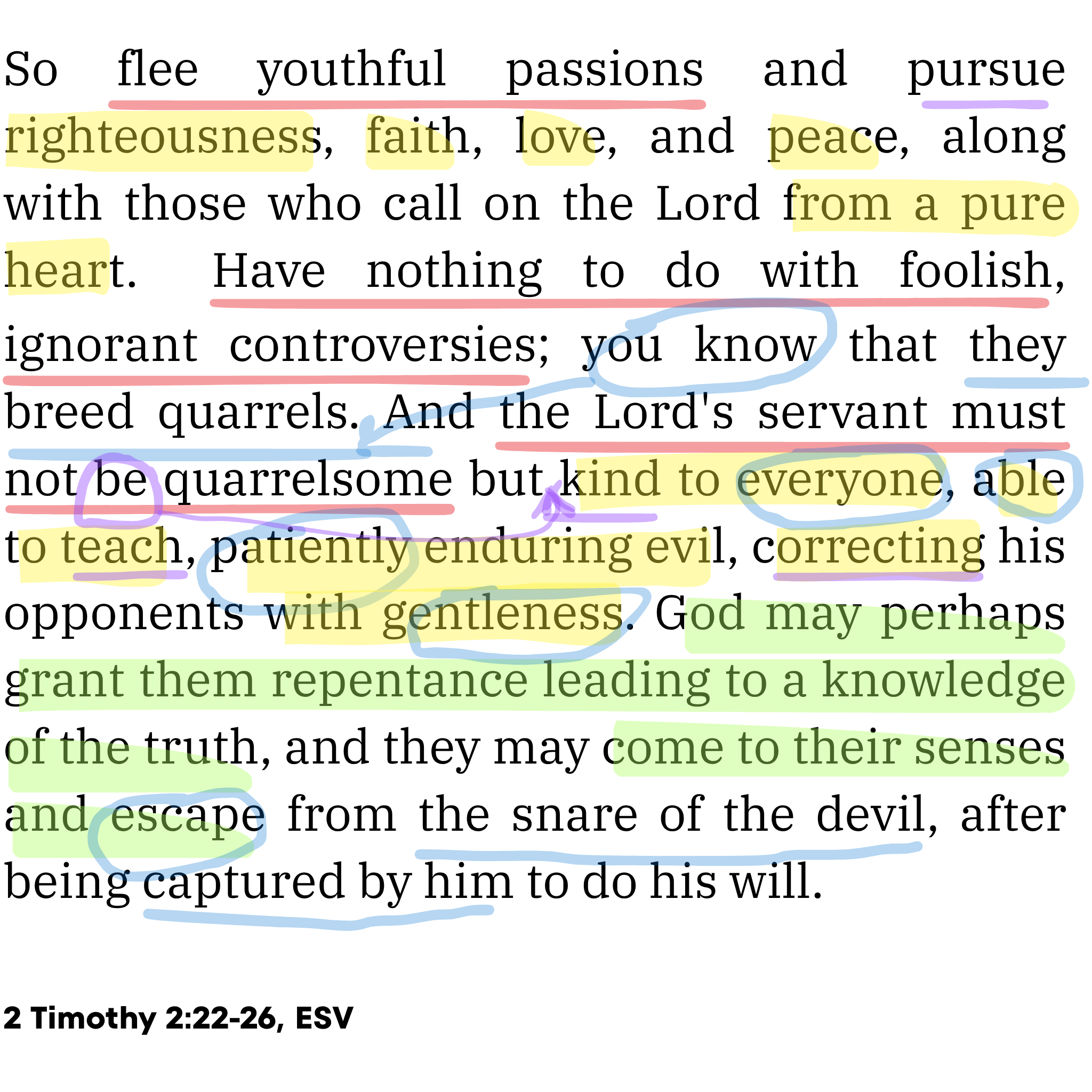
Take these words to heart:
These are not optional suggestions—this is the way Scripture instructs us to engage opposition after first examining our own hearts (2 Timothy 2:22–26).
- PURSUE righteousness and flee youthful passions, along with those who call on the Lord from a pure heart (2 Timothy 2:22).
- REFUSE foolish and ignorant controversies, knowing that they breed quarrels (2 Timothy 2:23). Practically: the world doesn’t need your opinion in every comments section, and you don’t need to re-share content that isn’t righteous, faithful, loving, and peace‑producing. Ask yourself: is it true, is it helpful, is it kind, and why am I sharing this?
- BE kind to everyone, because the Lord’s servant must not be quarrelsome but kind to everyone (2 Timothy 2:24).
- CORRECT opponents with gentleness, trusting that God may perhaps grant them repentance leading to knowledge of the truth (2 Timothy 2:25).
- REMEMBER THE REAL ENEMY—people are not the enemy; they are captives who have been held by the devil to do his will, and they need rescue, not rage (2 Timothy 2:26).
You don’t share the gospel by being a jerk. You don’t win souls by being arrogant. You don’t defend truth by abandoning love. Truth without love is brutality. Love without truth is deception. Christ commands both.
If you don’t actually have hope in your heart—if all that flows from you is anger—then maybe it’s time to ask:
What am I actually trusting in that keeps letting me down?
Because Jesus doesn’t let us down. He is our sure hope.
So whether you are addressing a brother or sister in Christ or engaging someone who does not yet know Him, remember this: the way you contend for truth must reflect the One who is truth. If your theology is right but your heart is hard, you are not defending the gospel—you are denying it in practice. Truth and love are not rivals. Holiness and compassion are not enemies. We don’t get to choose one or the other. We follow Christ by holding both together in how we treat one another and those enslaved by the devil and the trappings of this world.
Reflection Questions
- Where might self‑righteousness be hindering your Christian witness—and what specific next step will you take this week to recalibrate?
- How are you practicing correction with gentleness (2 Timothy 2:25) rather than reacting with hostility—what would that look like in one real conversation you expect to have?
- What would change in your online and in‑person interactions if your goal were not to “win” but to reflect Christ’s character (Galatians 5:22–23)?
Discover more from Marc Peter Coaching
Subscribe to get the latest posts sent to your email.
Thank you Marc, this is really helpful!